

A core update is a big, regular change to how Google ranks pages. Two are now close together, so here is what is known, who said it, and what I would do.
1. What happened with the November update
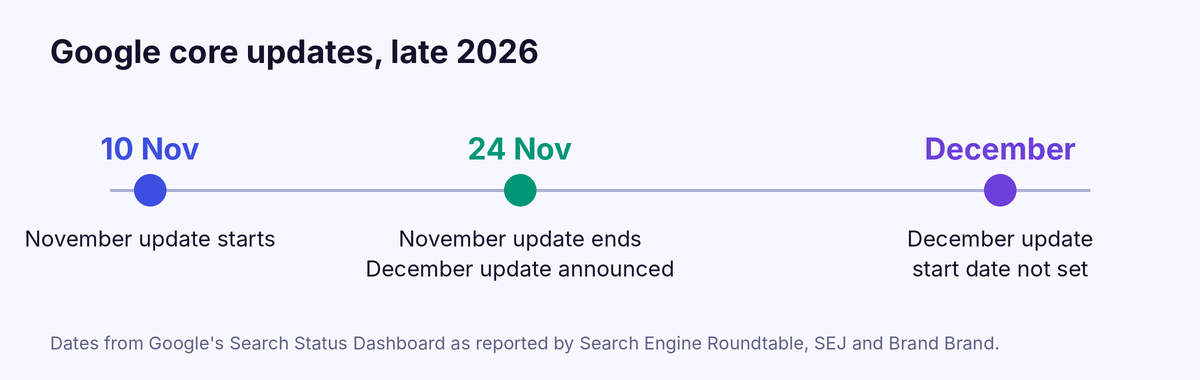
According to Brand Brand, the update started on 10 November at 18:06 UTC and ended on 24 November at 14:03 UTC, a little under 14 days. That matches the "up to two weeks" Google gave when it began.
Early reports came from outside Google, so treat them as observations, not facts. The same article says Glenn Gabe saw big rises and drops in Search Console from 13 November. Lily Ray reported six sites that lost whole folders of template pages, such as one page per word, per area code or per "X vs Y" comparison, while their product and brand pages held. Six sites is a small sample, not a rule.
What I take from this: if your site has many near-copy pages made from one template, look at those first. Look at them by folder, not one page at a time.
2. Google has already announced December
On 24 November, the same day the first update ended, Google said on its status page that a core update "is scheduled to be released in December 2026." It gave no start date. A Google spokesperson told Search Engine Roundtable that it will announce the start on the day, and that it is "not imminent."
Google also said what this one is about: "multiple improvements to how our systems understand and rank relevant content." It named two parts: longer and more complex questions, and personalized results for people who have personalization turned on. It applies to all countries and languages. Google says its normal core update advice still applies, and it gave no special checklist (Search Engine Journal).
Personalized results matter for how you measure. They can change the order of results for different people, though not every result. So one rank-tracker number may not match what your customer sees.
3. What I would do now
- Mark the dates. In Search Console, add notes for 10 November, 24 November and the December start day once Google announces it. SEJ suggests the same.
- Wait one full week, then compare. Google's advice is to wait at least seven days after an update ends, then compare that week with a week before it started. That means looking at 25 November to 1 December against 3 to 9 November. If you sell products, holiday shopping will make the comparison messy.
- Compare groups of pages. Group pages by folder or by type, such as blog, services and product pages. Then see which group moved.
- Judge the size of the drop. SE Handbook's summary of Google's advice says a small slip, like position 2 to 4, needs no change. A big drop that lasts, like position 4 to 29, needs a review of the whole site.
- Hold big edits. This is my advice, not Google's. December may come within weeks, so a rewrite now makes it hard to tell what caused any change.
One habit I keep that suits longer questions: answer the question in the first two lines of the page, then explain. Google did not say to do this for the update. It is just how I write for readers.
What I am not sure about
Nobody outside Google knows the December start date or what will move. The early November patterns come from a few sites. I will update this post when Google announces the start.
Sources
- Google's November core update is done, and another one comes in December (Brand Brand): dates and early observations.
- Google December 2026 core update preannounced (Search Engine Roundtable).
- Google announces December 2026 core update ahead of rollout (Search Engine Journal).
- Google November 2026 Core Update (SE Handbook): summary of Google's guidance.
- Google Search Status Dashboard: where Google posts update start and end times.