

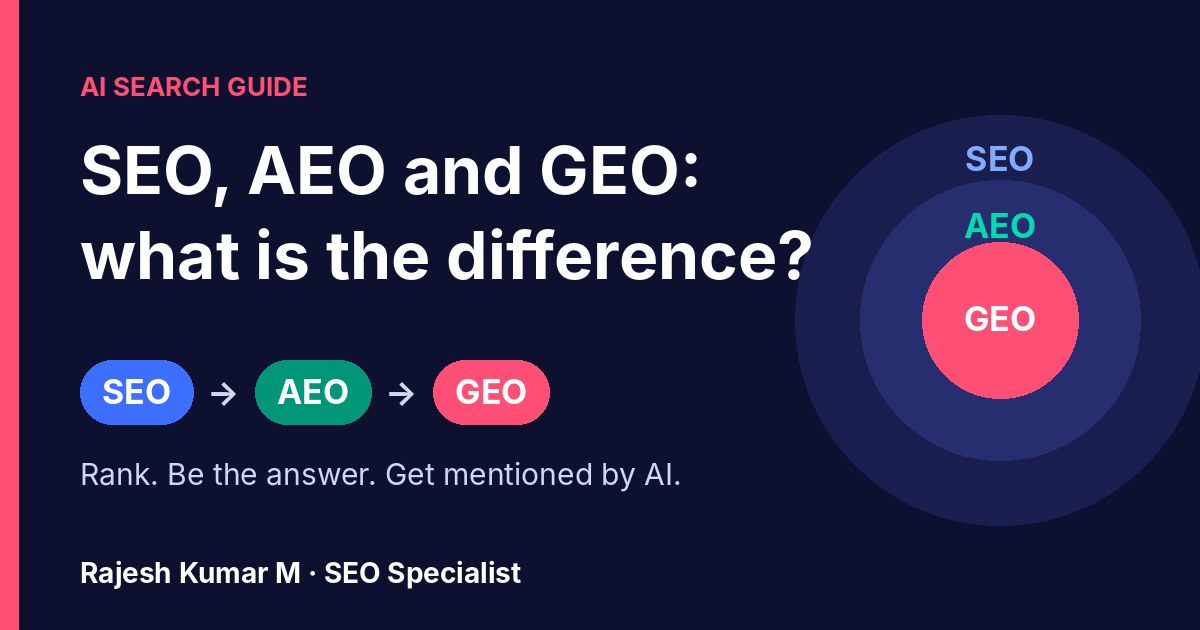
What is SEO?
SEO (search engine optimization) is the work of helping your pages show up in search results such as Google. It covers three parts: on-page SEO (titles, headings, content), technical SEO (crawling, speed, Core Web Vitals) and off-page SEO (links from other sites). The goal is more visits from people who search for what you offer.
What is AEO?
AEO (answer engine optimization) is about being the answer itself. People now often get an answer at the top of the results page, in a featured snippet, in Google's AI answers or from a voice assistant, without clicking anything. AEO means writing pages so these answers can be taken from you: a clear question as a heading, a short direct answer first, then the details.
What is GEO?
GEO (generative engine optimization) is about being mentioned in answers written by AI tools such as ChatGPT, Gemini, Claude and Perplexity. Here the question is not "do I rank?" but "does the AI name my brand, and does it get the facts right?" Nobody outside these companies knows exactly how they choose their sources, so GEO needs testing, not guessing.
How they work together
- Same base: useful pages, clear structure, fast loading and pages that search bots are allowed to read.
- Different goal: SEO measures rankings and clicks, AEO measures answers taken from you, GEO measures mentions in AI tools.
- Different checks: Search Console for SEO, snippet and AI answer checks for AEO, and regular tests of real questions in AI tools for GEO.
What to fix first
- Make sure bots can read your site. Check your robots rules, your sitemap and your page speed.
- Put the answer first. Under each question heading, give a short direct answer in the first sentence or two.
- Add clear structure. Use headings, short lists, tables and FAQs where they help the reader.
- Say who you are, the same way everywhere. Keep your brand name, what you do and your key facts the same across your site and profiles.
- Test with real questions. Write down the questions your customers ask, ask them in AI tools on a schedule, and note whether your brand shows up and whether the facts are right.
How I check this in my own work
I keep a list of real buyer questions, test them on ChatGPT, Gemini, Claude and Perplexity, and re-run them on a schedule. I record whether the brand is mentioned, which sources are cited, and what is wrong or missing, then turn it into a task list. It is a simple routine, and it works for any site.
Sources and further reading
- SEO Starter Guide (Google Search Central): the basics of how Google Search works and how to help it understand your site.
- AI features and your website (Google Search Central): how AI Overviews and AI Mode work with your pages.
- GEO: Generative Engine Optimization (arXiv research paper): the study that introduced the term GEO.